Why flat-fee influencer deals underperform
Flat-fee influencer deals underperform because brands pay for posts instead of results: you pay up front, the creator is paid for posting rather than converting, and every new ad means a new negotiation. A performance-based creator partnership pays only for tracked results, so an ad that doesn't convert costs nothing.

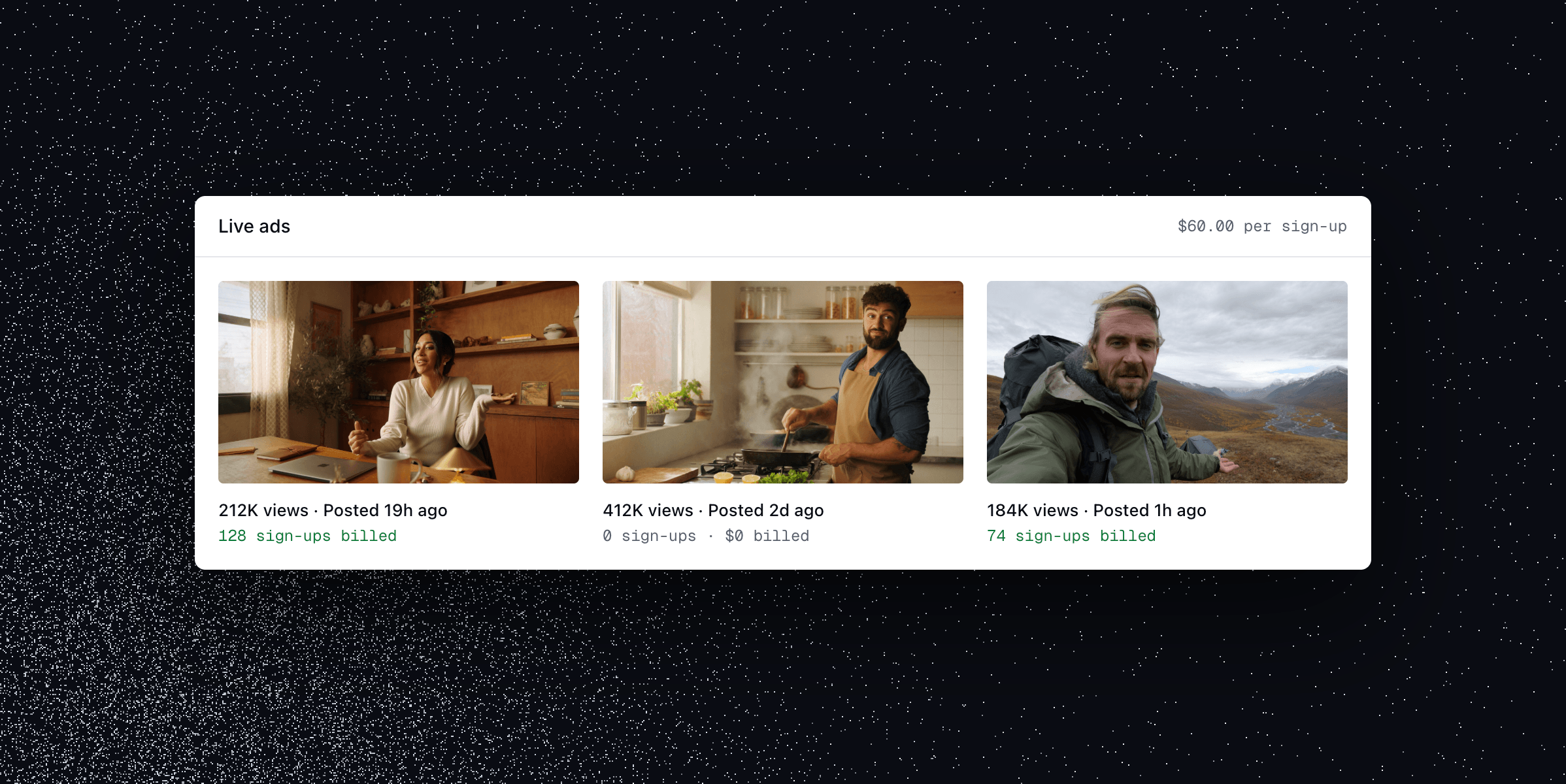
Flat fees were built before brands could trace a customer back to the creator who brought them, so paying for the post was the only workable option. Attribution has changed since then, but the deal hasn't. A performance-based creator partnership fixes the incentive: creators earn more when their ads convert, and the brand pays only for the results they drive.
On Panel, roughly 16 of every 100 ads that go live drive no results*, and brands pay nothing for them. Under a flat fee, every one of those ads would have been paid for in full.
Why flat-fee deals fall short
1. The model was built before modern attribution
Flat-fee deals come from a time when brands couldn't connect a customer to the creator who brought them. Without that link, paying for the post was the only workable option. Tracking links, promo codes and app attribution now make it possible to count the actual customers each creator drives, yet most deals are still priced as if none of that existed.
2. You pay before you know anything
The fee is agreed and paid up front or on publish. At the moment you commit, nobody knows whether the post will convert, so the brand carries all of the risk.
Brands try to close that gap with whatever data they can get. Creators send media kits, agencies share case studies, and talent managers forward screenshots of past results. That data is usually self-reported, often out of date, and measured on someone else's product. None of it tells you whether this creator will drive customers for your brand, or whether the fee is justified.
3. The creator's incentive ends at “posted”
Once the post is live and the deliverables are met, the creator has been paid. There's no reason to rework the hook, change the call to action, or post the version that's working again unless you pay another flat fee.
4. One post is one try
Winning creator ads usually come from testing many hooks and angles. A flat fee puts a price on every attempt, so testing gets expensive quickly and most teams stop after a few posts.
5. Small samples hide what works
With five or ten creators, you can't separate the creator from the audience, the creative or the timing. A good creator on a bad week looks like a bad creator, and the lesson you take away is often the wrong one.
6. Tracking is still an afterthought
Flat-fee deals are scoped around deliverables, like one video and two stories. Links, codes and attribution get added later, if at all, which makes results hard to prove in either direction.
7. Scaling means negotiating again
Every new creator is another rate negotiation, contract and deliverables list, and so is every new ad from a creator who's already working with you. That blocks both ways to grow. You can't scale with the creators who perform, because each extra post is another deal. And you can't scale the program as a whole without paying more up front for results you haven't seen yet.
Why performance-based creator partnerships hold up
A performance-based creator partnership is a deal where a brand sets a rate for a specific result, such as a signup, a funded account or a first deposit, and pays a creator only when that result is tracked to the creator's ad. Creators make ads to the brand's guidelines, and the brand approves every ad before it goes live. It answers each of the seven problems above, in the same order.
1. It's built on today's attribution
Tracking links, promo codes and app attribution are part of the deal from day one. The model works because a result can be traced to one creator's ad, so measurement is the starting point, not something added later.
On Panel, the same attribution works at every level. You can see results for a whole campaign, then drill down to a single ad from a single creator. It works the same way whether you're running 10 ads or 10,000, so measuring more ads never means more ad ops.
2. You pay after the result, not before
The brand sets the rate, and money moves only when a tracked result comes in. You don't have to judge a creator by a media kit or old screenshots; their results on your product decide what they earn.
3. The incentive runs past “posted”
A creator earns every time their ad drives a result, so a post going live is the start of the work, not the end. Reworking a hook, testing a new call to action or posting the version that works all pay off for the creator, without another fee from you.
4. Every try is free until it works
A creator ad that doesn't convert costs the brand nothing, so testing many hooks and angles stops being expensive. Creators test on their own, because the winning version is the one that pays them.
That's about 1 in 6 ads on Panel: roughly 16% of the ads that go live drive no results, and the brand pays nothing for any of them. The other 84% drove at least one paid result.*
5. More creators, clearer answers
Any creator who accepts the rate can run, so the program isn't capped at the five or ten deals a team can negotiate at one time. A wider sample shows which creators, audiences and angles actually work.
6. Tracking is the deal
Results are what the creator is paid for, so tracking is set up before launch and both sides look at the same numbers. There's no argument afterward about whether a post worked.
Panel connects with the partnership management platforms and mobile measurement partners (MMPs) brands already use, including Everflow, Impact, AppsFlyer and Singular, so results from creator ads show up directly in your preferred attribution platform, alongside every other channel.
7. Scaling without renegotiating
The rate is set once. A creator who performs can post as many ads as they like without a new negotiation, and new creators join at the same rate. You can grow with your best creators and across the whole program at the same time, and spend rises only when results do.
At a glance
The seven differences, side by side:
| Flat fee | Performance-based creator partnership | |
|---|---|---|
| 1. Attribution | Priced as if results can't be tracked | Built on tracked results |
| 2. When you pay | Up front or on publish | Only when a tracked result comes in |
| 3. Creator's incentive | Ends when the post goes live | Lasts as long as the ad converts |
| 4. Cost of an ad that doesn't convert | The full fee | Nothing |
| 5. Number of creators | The handful you negotiated with | Any creator who accepts the rate |
| 6. Tracking | Added after the deal | Set up before launch |
| 7. Scaling | A new negotiation for every creator and every ad | One rate for every creator and every ad |
When a flat fee still makes sense
Flat fees aren't always wrong. They fit when you're buying something other than a measurable action:
- Reach for a launch or awareness push, where the goal is attention, not conversions.
- One specific creator, whose name you need more than their audience's response.
- Content you plan to reuse as paid ads, where you're buying the asset.
An example: Buffalo Wild Wings' sponsored content with comedian Druski (YouTube, February 12, 2026). Most of what a restaurant sells happens in store, where a sale is hard to tie back to one video. What a deal like this buys is attention: a place in the conversation around a creator people are actively talking about, so the brand comes to mind the next time someone decides where to eat. That kind of impact builds over months, not in the hours after a post goes live, and a flat fee is a reasonable way to pay for it.
If the goal is signups, accounts or deposits, use a performance-based creator partnership instead.
How to move from flat fees to performance-based creator partnerships
- Pick the result you'll pay for. Choose the step in your funnel that matters to the business: a signup, a funded account, a first deposit or a completed quote.
- Set a rate per result. Start from what that customer is worth to you, not from what you used to pay per post.
- Set up tracking before launch, so every result ties back to one ad.
- Write your guidelines: the claims you can and can't make, required disclosures, and what you'll approve.
- Open it to many creators. Approve ads as they come in and let the results show which angles work.
- Raise the rate on what's working instead of renegotiating deal by deal.
On Panel, this is the default setup. You set the rate and a maximum monthly spend, creators choose to run your campaign, you approve every ad before it goes live, and you're billed only for results tracked to their ads.
See how it works in your category: fintech (funded accounts), sports betting and prediction markets (first deposits), insurance (completed quotes), legal (qualified cases), health and wellness (paid subscribers) and travel (bookings).
FAQ
Is a performance-based creator partnership the same as affiliate marketing?
No. Affiliate programs usually pay a commission on sales through a link the creator shares, with little say over the content. In a performance-based creator partnership, the brand chooses the result it pays for at any step of the funnel, creators make ads to a brief, and the brand approves every ad before it goes live.
Is a small fee plus a per-result rate a good middle step?
Usually not. A hybrid sits close to an affiliate structure, and the fixed fee tends to be fine-tuning rather than a real change in who carries the risk. It can also slow scaling, because a hybrid program needs extra infrastructure to run automatically. The main advantage of a performance-based creator partnership is dropping the back-and-forth and ad ops that come with flat-fee negotiations at scale, and a hybrid brings much of that back.
How do I set the right rate?
Work back from what a new customer at that funnel step is worth to you. A rate set too low won't attract creators; a rate set from old per-post fees usually has no link to results.
About the data
* Based on ads that went live on Panel between 01/26 - 10/26. A result is one single tracked ad conversion the brand paid at least $1 for.
Talk to our team
Ready to stop paying for posts that don't convert? Book a call with Panel's sales team to see how a performance-based creator partnership would work for your brand: the result you'd pay for, the creators who'd run it, and how results would show up in your attribution platform.
Keep reading


Ready to run creator ads that perform?
Creators make the ads, you approve every one, and you’re billed only for results tracked to them. Leave your work email and we’ll show you how it would work for your brand.